Select Page Style

(sets a browser cookie) (X) Some styles may be disabled for Internet Explorer

Research in Categorical Algebra

A bicategory is a kind of (weak) 2-category, and classical Morita theory can be phrased in terms of a classical example of a bicategory. This is the bicategory whose 0-cells are rings, 1-cells are bimodules, and 2-cells are bimodule homomorphisms. The unit 1-cell over a ring is that ring considered as a bimodule over itself, and composition of 1-cells is defined by the tensor product.
A Morita equivalence of rings is simply an equivalence of 0-cells in this bicategory. That is, a 1-cell from one ring to another (a bimodule), with a 1-cell inverse, so that the composite (tensor product) of these two bimodules over one ring is isomorphic to the other, and vice-versa.

These projects use the bicategorical perspective to give a conceptual unification of various generalizations of Morita theory, including Morita theory for derived categories of rings and for ring spectra. Further work develops the concepts of Azumaya algebras and Brauer groups in bicategorical generality, with an aim toward homotopy-theoretic applications.

Introductory Slides

Enriched Morita Theory

Slides (UIUC, 2008)
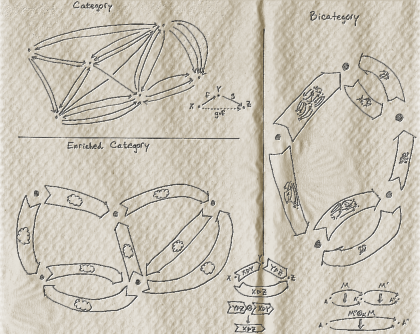
napkin drawing

Napkin depiction of a category, an enriched category, and a bicategory.


These slides present classical Morita theory from the perspective of enriched categories. Their aim is to introduce both enriched and bicategorical concepts as they relate to Morita theory. The slides were presented at a talk during the 2008 Graduate Student Topology Conference.


Morita Theory and Azumaya Objects in Bicategorical Contexts

Slides (Washington, D.C., 2009)

Abstract: These slides are from a talk at the 2009 Joint Meetings Special Session on Homotopy Theory and Higher Categories. Morita theory provides a wonderful first example of bicategorical structure in classic algebra. Generalizations of the Picard group, Azumaya algebras, and the Brauer group are now a part of higher-categorical folklore. However, these are important algebraic concepts not only because they have pleasing definitions but also because they are calculationally accessible. This talk will explain how to generalize those results from algebra which make these concepts so accessible, and describe some examples of interest to topologists and algebraists. The essential tools: duality and our friend the (bicategorical) Yoneda lemma.

Morita Theory for Derived Categories: A Bicategorical Perspective

arXiv 0805.3673 (2008): [abs | pdf]

Abstract: We present a bicategorical perspective on derived Morita theory for rings, DG algebras, and spectra. This perspective draws a connection between Morita theory and the bicategorical Yoneda Lemma, yielding a conceptual unification of Morita theory in derived and bicategorical contexts. This is motivated by study of Rickard's theorem for derived equivalences of rings and of Morita theory for ring spectra, which we present in Sections 2 and 4. Along the way, we gain an understanding of the barriers to Morita theory for DG algebras and give a conceptual explanation for the counterexample of Dugger and Shipley.

Azumaya Objects in Bicategories

arXiv 1005.4878 (2011): [abs | pdf]

Abstract: We introduce the notion of Azumaya object in general homotopy-theoretic settings. We give a self-contained account of Azumaya objects and Brauer groups in bicategorical contexts, generalizing the Brauer group of a commutative ring. We go on to describe triangulated bicategories and prove a characterization theorem for Azumaya objects therein. This theory applies to give a homotopical Brauer group for derived categories of rings and ring spectra. We show that the homotopical Brauer group of an Eilenberg-Mac Lane spectrum is isomorphic to the homotopical Brauer group of its underlying commutative ring. We also discuss tilting theory as an application of invertibility in triangulated bicategories.

Categorical classification of stable one and two-types

This project is joint with Angélica Osorno and Peter May.

This is work in progress.

Connected spaces with non-trivial homotopy groups only in degrees one and two (two-types) can be classified by crossed modules or, equivalently, by strict 2-groups (a.k.a. Picard groupoids). This project, partially inspired by the 2-exact sequences for maps of Picard groupoids introduced by Enrico Vitale, aims to classify stable two-types using a similar strategy.

The first phase of this project, involving Angélica and myself, identifies the Postnikov data of a stable one-type and describes a model for the cofiber of a stable one-type. The second phase, on which the three of us are working, expands this to model stable two-types.


Stable One-Types

Joint with Angélica Osorno

arXiv 1201.2686: [abs | pdf]

Slides (JMM 2012, Boston)

Abstract: It is a classical result that groupoids model homotopy 1-types, in the sense that there is an equivalence between the homotopy categories, via the classifying space and fundamental groupoid functors. We extend this to stable homotopy 1-types and Picard groupoids.
    Using an algebraic description of Picard groupoids, we give a model for the Postnikov invariant of a stable 1-type and describe the action of the truncated sphere spectrum in these terms. We relate this data to exact sequences of Picard groupoids developed by Vitale, constructing a model for the homotopy cofiber of a map of stable 1-types.

Azumaya and Brauer Theory in Tensor Triangular Categories

This is work in progress.

This project aims to develop an understanding of Azumaya objects in monoidal triangulated categories without internal Hom objects, motivated partially by the work of Paul Balmer. Azumaya objects are necessarily dualizable, and duals satisfy some of the same formal properties that certain internal Hom objects do, so it is natural to develop the theory in a setting which assumes these. However there are triangulated categories of interest which, although they do have a tensor (monoidal) structure, do not have internal Hom objects. It is possible to rephrase the definition of Azumaya in terms of a monoidal structure only, and this project works out the formal properties, characterization theorem, and interesting examples in this case.

Contact Information

Niles Johnson
Department of Mathematics

Boyd 526
200 D. W. Brooks Drive

University of Georgia
Athens, GA 30602-5016

706-542-2210

Display e-mail address

for more information, see the contact page

arXiv author identifier

johnson_n_1
(what's this?)

Office Hours

Tue, 3pm,
Thu, 2pm.